 Parker Conley
 ChatGPT

Use a responsibility worksheet to agree who tests, follows up, reviews, and retains community-pool records between contractor visits.
Separate service visits from the full operating schedule
A service agreement may describe cleaning and equipment work without assigning every testing or recordkeeping task needed while the pool operates. Before the season begins, have the property manager and contractor compare the visit schedule with the facility’s required operating routine.
Write down the gaps as questions: who covers days without a visit, who responds after hours, and who can make an operating-status decision? The contract should describe the actual arrangement. It does not by itself remove duties imposed by applicable rules.
Build a responsibility worksheet
For each task below, name the primary person, backup, timing, record location, and escalation contact. Fill in people or defined roles that your team recognizes; “the pool company” is too vague for a task that may arise between visits.
- Routine tests during contractor visits and between visits.
- Review of entries and follow-up on missing or unresolved records.
- Corrective work, subsequent testing, and communication of restrictions.
- Equipment repair approvals and urgent escalation.
- Record exports, secure storage, and retention.
- Inspector access and handover when the manager or contractor changes.

Test the arrangement with a real scheduling gap
Imagine the contractor leaves Friday morning and the next visit is Monday. If the applicable procedure calls for work in between, who performs it and where is it recorded? Give that person access to the right form, training for the assigned work, and an escalation route.
Then imagine the assigned person is unavailable. A backup is useful only if they know they are the backup and can perform the task. Record the escalation contact when no authorized person is available. Do not fill a scheduling gap with an assumption that a remote reading replaces required work.
Keep the records with the property
Choose a storage location controlled by the organization responsible for the records, with appropriate access for the service provider. Avoid leaving the only archive in one employee’s personal account. If a vendor owns the software subscription, agree on export access and the handover process before changing providers.
Use a shared naming convention for the facility and each body of water. Ask for a sample export during onboarding and open it yourself. A folder of unidentified CSV files is not a useful handover simply because the files exist.
Close the loop when staff or vendors change
At transition, list the remaining tasks, latest records, contact details, and access changes. Confirm who receives the archive and where new entries begin. Keep the old records according to the rules that apply rather than deleting them when a contract ends.
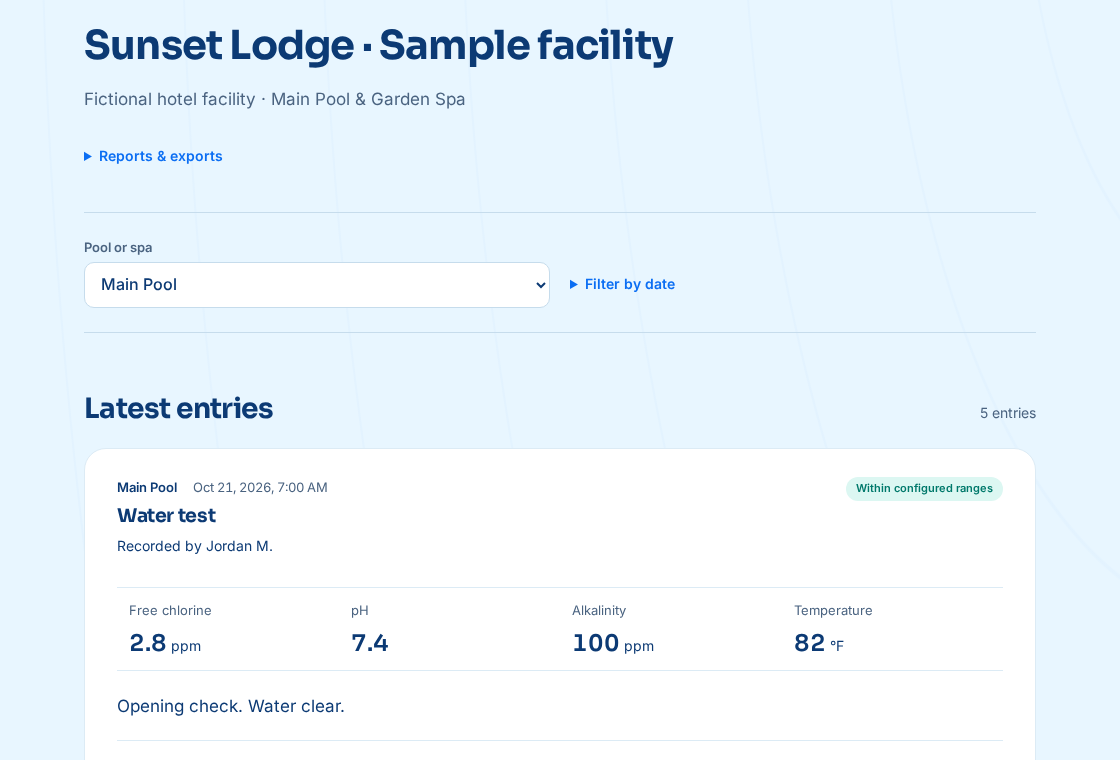
For SwimmingPoolLog, the facility PIN unlocks entry and staff supply their name. Change that PIN when access needs to change; do not treat the entered name as proof of a separately authenticated staff account. Review the facility’s public log visibility before deciding which information belongs there.

Less paperwork.
More poolside.
Give every pool a QR sign and every shift a clear record. Start with one pool and see how it fits your team.
Start your free trial →14 days free · No card needed · $15 per pool / month
Try the interactive demo